
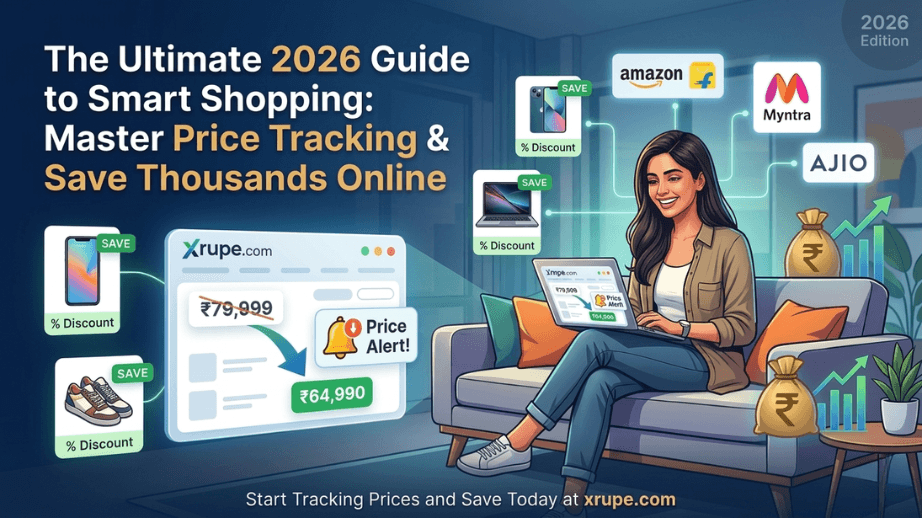
Chapter 1: The Psychology of the "Price Tag" in the Digital Age
The internet promised us transparency, but it delivered complexity. In 2026, the price you see on an e-commerce storefront like Amazon or Flipkart is rarely "the" price. It is a data point—a result of complex algorithms, supply chain fluctuations, and competitor tracking.
The Illusion of the Sale
Most consumers wait for "Big Billion Days" or "Great Indian Festivals," believing these are the only times to save. However, data from platforms like xrupe.com shows that prices for specific items—like the latest iPhone 17 Pro or high-end Sony headphones—often hit their lowest points during random Tuesday afternoons, far away from the marketing hype of major sales.
Why We Overpay
We overpay because of "FOMO" (Fear Of Missing Out). When a site says "Only 2 left in stock!" or shows a countdown timer, our brain shifts from logical analysis to emotional urgency. A reliable price tracker acts as a digital "cooling-off period." By using a tool like xrupe, you move from a reactive shopper to a proactive strategist.
Chapter 2: Understanding the Tech – How Price Tracking Actually Works
Before you dive into saving, it’s important to understand the "engine under the hood" of a modern price comparison tool.
1. Web Scraping and Data Fetching
A platform like xrupe.com uses advanced "crawlers." These are automated scripts that visit 14+ stores (Ajio, Croma, Myntra, etc.) every few minutes. They extract the current price, availability, and shipping terms.
2. Price Normalization
Every store displays data differently. Amazon might list a price as "₹79,999 inclusive of all taxes," while another site might show a base price plus GST at checkout. A high-quality tracker normalizes this data so you can compare "apples to apples."
3. The Power of the "Target Alert"
The most sophisticated part of the tech is the Alert Engine. Instead of you checking the site 20 times a day, you tell the server: "Notify me when this drops below ₹70,000." The server then runs a constant check. The moment the crawler detects that specific value, it triggers a notification via email or browser alert.
4. Why Multi-Store Tracking is Essential
In the past, people only tracked Amazon. Today, the Indian e-commerce landscape is fragmented. A Samsung Galaxy S25 Ultra might be ₹1,29,999 on Amazon but ₹1,15,000 on the Samsung Corporate store or Croma for a flash 2-hour window. If your tracker only looks at one store, you are missing 90% of the deals. xrupe solves this by aggregating 14+ stores into one dashboard.
Chapter 3: Step-by-Step Guide to Using xrupe for Maximum Savings
To the uninitiated, price tracking might seem like a technical chore. However, modern platforms have distilled this into a three-step process that takes less than thirty seconds. Here is how to master the xrupe.com workflow.
1. The Discovery Phase: Finding Your URL
Your journey doesn't start on the tracker; it starts on the retailer's app or website. Whether you are browsing for a new pair of Nike sneakers on Myntra or a high-end laptop on Amazon, find the specific product page. Use the "Share" button on your mobile or copy the URL from your browser's address bar.
2. The Integration: Pasting and Analyzing
Navigate to xrupe.com. The interface is designed for speed—no cluttered ads or unnecessary pop-ups. Paste your link into the central search bar. The system instantly recognizes the store (be it Flipkart, Ajio, or Croma) and fetches the current "Live Price."
3. Setting the "Strike Price"
This is where most shoppers fail, and where xrupe users win. Don't just track the price—set a target. * The 10% Rule: For high-demand electronics (like iPhones), a 10% drop is a strong signal to buy.
- The Seasonal Buffer: For fashion, aim for a 30-40% drop, as inventory turnover is faster. Enter your email, set your target price, and "Set Alert." You are now officially a "passive saver."
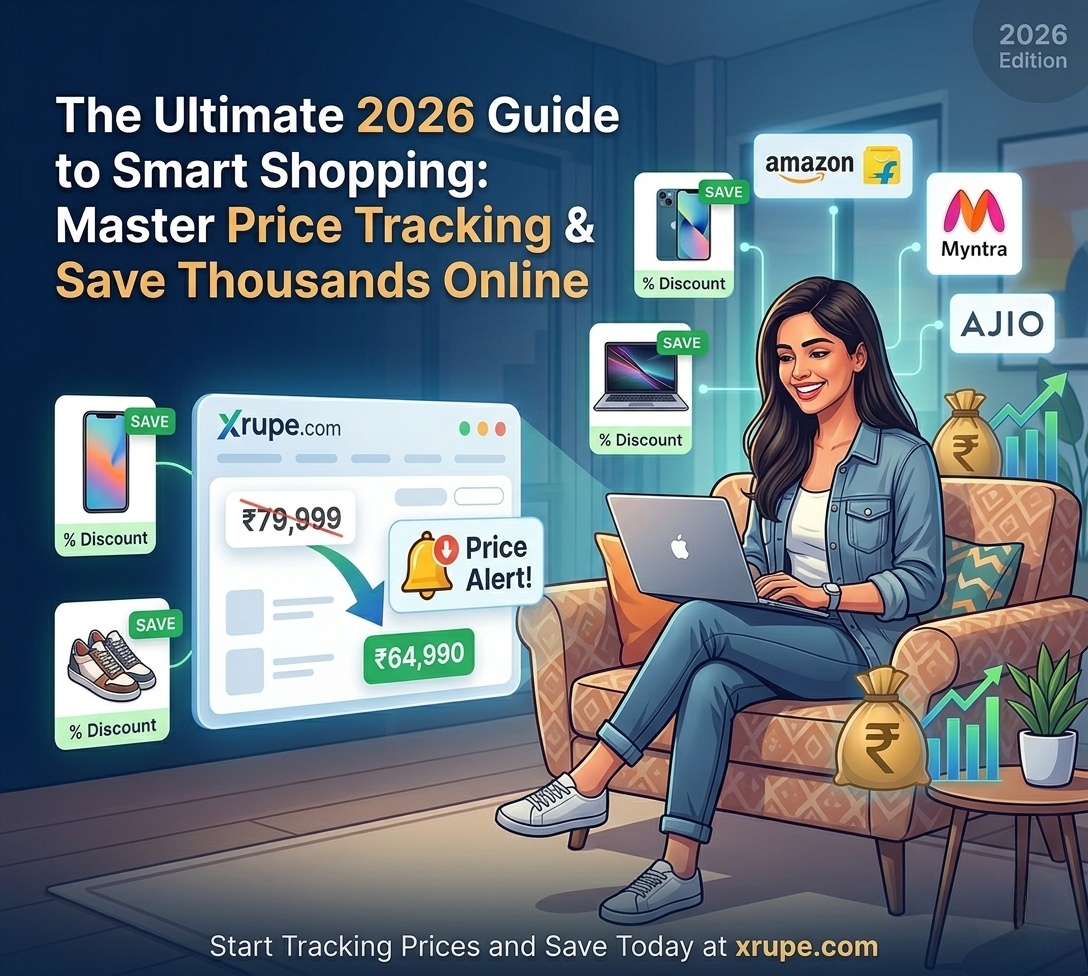
Chapter 4: Case Studies – Why Different Categories Need Different Strategies
Price tracking is not a "one size fits all" game. Different industries use different pricing algorithms. Understanding these can save you thousands.
A. The Electronics Market: The "Volatility" King
Electronics (Mobiles, Laptops, TWS) have the highest price volatility. Because of rapid launch cycles, older stock must be cleared.
- The Mid-Week Dip: Surprisingly, data suggests that electronics often see price drops on Tuesday and Wednesday nights to stimulate mid-week sales.
- The Bundle Trap: Often, a store will keep the price high but offer "Bank Discounts." xrupe helps you see the base price so you can decide if the bank offer is actually a deal or just a marketing gimmick.
B. Fashion & Lifestyle: The "Inventory" Game
On platforms like Ajio and Myntra, prices change based on size availability.
- The "Last One" Surge: If only one Medium-sized shirt remains, the price might actually rise. By tracking the item, you can wait for a restock when the price often resets to a lower introductory rate.
- Flash Sales: Fashion sites love 2-hour windows (e.g., 12 PM to 2 PM). Unless you are glued to your phone, you'll miss them. xrupe’s 24/7 monitoring ensures you get the alert while the stock is still there.
C. Home Appliances: The "Comparison" Necessity
When buying a refrigerator or washing machine, the price difference between Croma, Amazon, and Reliance Digital can be as high as ₹5,000 for the exact same model.
- Shipping & Installation: While trackers focus on the sticker price, always use the tracker to find the lowest base. Since xrupe tracks 14+ stores, it prevents you from buying on one site only to realize it was significantly cheaper on another "verified" store you forgot to check.
Chapter 5: Advanced Tactics – Beyond the Basic Alert
If you want to join the top 1% of "Super Shoppers," you need to use these advanced psychological and technical tactics.
1. Tracking the Competition (The "Multi-Store" Pivot)
If you find a product on Amazon, don't just track the Amazon link. Search for that same product name on xrupe. The platform will show you if it’s currently cheaper on Flipkart or Tata Cliq. Always track the "market leader" price.
2. The "History" Perspective
Before setting an alert, look at the price history. If a TV is currently ₹45,000 but was ₹38,000 last month, do not buy. The history proves that a ₹38,000 price point is possible. Set your alert for ₹38,500 and wait. Patience is the ultimate discount code.
3. Avoiding "Fake" Discounts
Many retailers raise prices two weeks before a major sale, only to "discount" them back to the original price during the event. Price trackers expose this "inflation-discount" cycle. If the "discounted" price is higher than the average price from three months ago, it’s not a sale—it’s a trap.
Chapter 6: The AI Revolution – How Machine Learning is Changing Your Cart
As we move through 2026, the battle for your wallet isn't just between retailers; it’s between algorithms. On one side, retailers use "Dynamic Pricing AI" to raise prices the moment they detect high demand. On the other side, tools like xrupe.com act as the consumer’s digital shield.
1. Predictive Analytics
In the very near future, trackers won't just tell you what the price is; they will tell you what it will be. By analyzing years of historical data, seasonal trends, and even global supply chain news, AI can predict with 85% accuracy if a product will be cheaper next week. If xrupe shows a "Hold" signal, it means the data suggests a price drop is imminent.
2. Hyper-Personalization vs. Privacy
Many shopping apps track your behavior to show you higher prices if they know you are an "impulse buyer." Using a third-party tracker allows you to monitor the market anonymously. You see the "clean" price—the one offered to the general public—not a price inflated based on your personal browsing history or your expensive smartphone model.
Chapter 7: Security and Trust in Price Tracking
In an era of data breaches, users are rightfully cautious. A common question arises: "Is it safe to use a price tracker?"
1. No Account, No Problem
The brilliance of the xrupe model is the lack of friction. By allowing users to track prices without forced signups or social media logins, the platform minimizes the "data footprint." You aren't giving away your life story; you’re just asking for a price update.
2. Verified Stores Only
One of the biggest risks in online shopping is falling for "scam" websites offering prices that are too good to be true. xrupe mitigates this by only indexing verified, reputable retailers like Amazon, Flipkart, Ajio, and Croma. If a deal appears on xrupe, you know it’s coming from a legitimate business with a real refund policy.
3. Avoiding Ad-Injection
Some low-quality browser extensions "track prices" while secretly injecting their own ads into your browser or stealing your cookies. Web-based platforms like xrupe avoid this entirely. Since you are using a clean web interface, your browser remains secure and your private shopping sessions stay private.
Chapter 8: The Smart Shopper’s Manifesto – 10 Commandments for 2026
To wrap up this guide, here is the definitive "Manifesto" for anyone looking to master their finances through smart e-commerce.
- Never Buy on Impulse: If it costs more than ₹2,000, it stays in the tracker for at least 24 hours.
- Verify the "Sale": A "50% Off" tag is meaningless. Only the price history tells the truth.
- Cross-Reference Always: Amazon is not always the cheapest. Check the xrupe dashboard for Croma or Tata Cliq alternatives.
- Set "Realistic" Alerts: If a phone is ₹50,000, don't set an alert for ₹10,000. Aim for the "historical low" plus a 2% margin.
- Ignore the "Timer": Countdown clocks are often psychological tricks. If the tracker says the price is average, ignore the clock.
- Use Bank Offers as "Extra": Calculate your savings based on the base price. Bank discounts should be the cherry on top, not the reason for the purchase.
- Check Shipping Costs: Sometimes a lower price on one site is offset by a high shipping fee.
- Be Patient with Fashion: Clothing has the highest markup. If you wait, it will drop.
- Track Your "Wins": Keep a mental log of what you’ve saved. It turns "frugality" into a rewarding game.
- Share the Knowledge: Help others avoid overpaying. The more people use trackers, the more retailers are forced to keep prices competitive.
Conclusion: Reclaiming Your Financial Power
The digital marketplace was designed to be a maze, but you now have the map. By integrating a multi-store price tracker like xrupe.com into your daily routine, you transition from a "target" for marketing departments into a sophisticated market participant.
In 2026, saving money isn't about working harder—it's about shopping smarter. You have the tools, you have the data, and now, you have the strategy.
Happy Saving!
Comments
No comments yet
Be the first to share your thoughts!
Leave a Comment
Your email address will not be published.